To Top




Which Board Is Best in Mumbai Schools
My daughter once asked me why her friend at a different school studies completely different things. Same grade, same city, same age — but a totally different world inside the classroom. I didn't have a quick answer. Because honestly? The board question is one of those decisions that sounds administrative on the surface but turns out to be one of the most personal choices a parent makes.
Mumbai is unusual in this way. You can live in Borivali and choose between four different boards within a reasonable commute. You can be in Thane and face the same problem. Most Indian cities don't offer this kind of variety — and so most parents elsewhere don't wrestle with it the way Mumbai parents do. Here, the decision requires real thought.
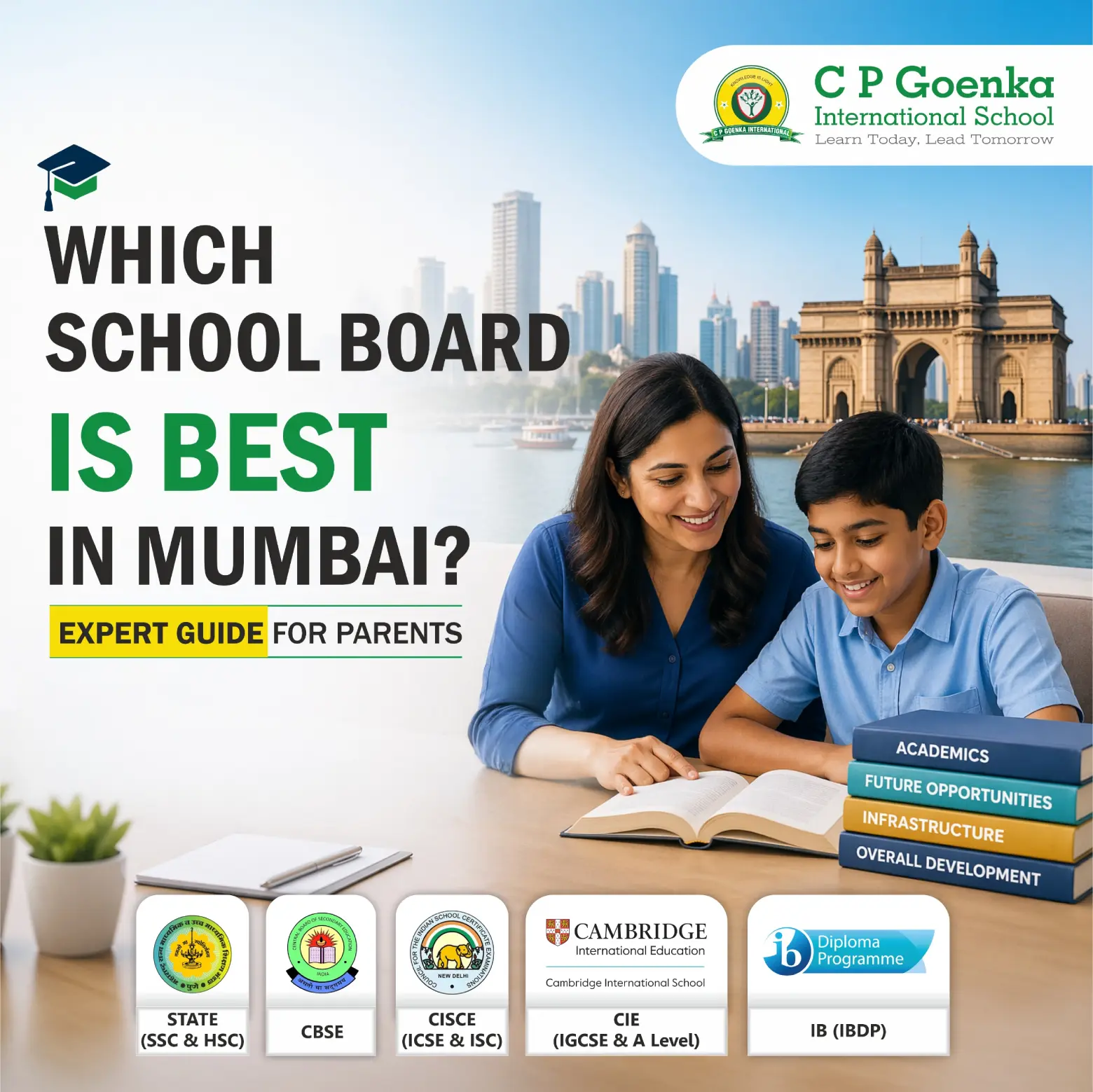
I've spent a lot of time around educators, school counsellors, and parents who've already been through it. What follows is not a ranking. It's an honest breakdown — the kind of conversation you'd have over dinner with someone who actually knows these systems from the inside.
Start With the Child, Not the Board
This sounds obvious. It rarely gets applied.
Most parents start by asking which board has the best reputation, or which one their neighbour chose, or which produces the most toppers. Those are the wrong first questions. The right first question is: who is this child in front of me, and how do they actually learn?
Some children are naturally verbal. They read ahead of their age, narrate everything they observe, and find writing almost effortless. Others are more spatial and logical — they'd rather build something or solve a problem than write about one. Some children need clear structure to feel safe; others feel caged by it and only open up when given room to explore.
Boards are not interchangeable. They reward genuinely different abilities. Putting the wrong child in the wrong system — even a prestigious one — is something you often won't notice until Class 7 or 8, when the accumulation of misfit starts showing up as disengagement, anxiety, or that hollow kind of "fine" that parents learn to dread.
So before anything else: know your child.
CBSE — The Most Practical Choice for Modern Indian Families
CBSE is what most Mumbai families default to, and it's not without reason.
The curriculum travels. If you're in a profession that moves you between cities — and in Mumbai, plenty of people are — CBSE means your child doesn't lose ground. The syllabus in Andheri is the same one running in Bangalore, Chennai, and Gurugram. That portability has real value.
More importantly, India's biggest entrance exams are built around CBSE. JEE, NEET, CUET — these are effectively CBSE exams with a different cover. Coaching institutes know this content cold. For families where medicine or engineering is on the horizon, choosing CBSE removes a translation layer that otherwise costs time and energy in Class 11 and 12.
The honest limitation: CBSE is a framework, not a guarantee. The difference between a well-run CBSE school and a poorly run one is enormous, and both technically carry the same board affiliation. When you're evaluating a CBSE school, look past the board and look at the teachers, the classroom culture, how questions are handled, whether children seem curious or just compliant.
CBSE also tends to be more exam-oriented than inquiry-oriented. That works for certain temperaments beautifully. For children who need to understand the why before they can engage with the what, it can feel like being asked to build furniture without knowing what room it goes in.
Fits best: families with mobility, children targeting JEE/NEET, students who work well within structured, exam-focused systems.
ICSE — Deeper, More Demanding, Worth It for the Right Child
ICSE has a particular kind of gravity in Mumbai. Schools with long ICSE traditions — and there are several — produce graduates who tend to be noticeably better writers, more widely read, and more comfortable with academic complexity. That's not a coincidence. It's the curriculum doing its job.
English is treated seriously here — not just as a medium but as a subject. Literature, composition, comprehension — these get real attention and real time. Science and humanities are both taught with more depth than comparable grades in other boards. The student who comes out of a good ICSE Class 10 has been genuinely worked.
But "genuinely worked" is the important phrase. ICSE is heavy. The load is real from fairly early on, and for children who struggle with writing, who find language-based tasks effortful, or who are simply more mathematical in how they think, the cumulative weight can become a source of chronic stress rather than productive challenge. That's not a failure of the child. It's a mismatch between the system and the learner.
Fits best: strong readers and writers, children interested in humanities or pursuing international universities, families who value depth in English-medium education.
IGCSE — The International Track, and More Accessible Than It Used to Be
Ten years ago, Cambridge IGCSE felt like a rarefied option in Mumbai — expensive, international, and somewhat out of reach for most families. The landscape has shifted. Several well-established schools now offer IGCSE programmes across the city, and the credential itself has grown in familiarity and respect.
IGCSE followed by A-Levels is one of the clearest pathways to international university admissions that exists. Universities in the UK recognise A-Level grades with minimal ambiguity. Universities in Canada, Australia, and increasingly the US understand the system well. For families where studying abroad is a genuine plan — not just a vague aspiration — this pathway removes a lot of the uncertainty involved in converting Indian board results for foreign admissions offices.
The learning approach is analytical. Students are assessed on understanding and application, not on reproduction of memorised content. For children who think in questions — who want to understand how something works, not just that it works — the Cambridge framework can feel like the first educational system that actually makes sense to them.
The practical consideration is cost and availability. IGCSE schools in Mumbai tend to be more expensive than CBSE or ICSE options, and not every neighbourhood has good access. These are real factors. The best education is one your family can sustain comfortably over twelve years, not one that requires ongoing financial strain.
Fits best: children planning international university admissions, analytical learners, families where the fees are workable without stress.
What 25 Years of Watching Children Learn Has Taught Us
At C.P. Goenka International School —across our campuses in Oshiwara, Thane, Borivali, Ulwe, and Walkeshwar—we've been sitting with this question longer than most. Over 25 years, across thousands of students, you start to see patterns that no syllabus document captures.
The child who becomes a world topper in IGCSE Mathematics is rarely the same profile as the child who finds their voice in an ICSE literature classroom. Both are intelligent. Both have potential. But they need different environments to realise it. We've watched children arrive uncertain and leave confident —not because we pushed them harder, but because the framework finally matched how their minds actually worked.
We offer CBSE, ICSE, and Cambridge IGCSE and A-Level programmes because we've seen that no single board is universally right. What we look for —in every admission conversation, in every classroom —is fit. The right match between a child's learning style and the programme they enter is worth more than any board ranking.
Our world toppers and national toppers didn't get there because of the board they were in. They got there because they were in the right programme, supported by teachers who understood what they needed, in an environment that took their development seriously.
Before You Decide: Three Questions Worth Sitting With
Not three quick questions. Three questions you actuallythink about.
What does your child gravitate toward when nobody is watching? Not what they perform well at for exams —what genuinely holds their attention. The answer often points directly toward the kind of learning environment where they'll thrive.
Where do you realistically see your child at 22? In Indian professional colleges, at an international university, still figuring it out? Each of these trajectories has a board that serves it better. Honest answers here save years of misalignment later.
What can your family sustain —financially and emotionally —for twelve years? A school that stretches you to breaking point is not a neutral educational choice. The tension travels home with you, and children absorb it. The best school is one where the choice feels considered, not desperate.
The Honest Conclusion
Mumbai's diversity of educational options is genuinely something to be grateful for. Parents here have real choice in a way most Indian cities don't. The challenge is that real choice requires real thinking —not just about which board sounds best at a dinner party, but about who your child is and what they actually need.
Visit schools in person. Ask to observe a class, not just tour the building. Talk to parents whose children are a year or two ahead. Notice how teachers respond when children ask questions they weren't expecting. Those moments tell you more than any brochure will.
The board matters. But it matters less than the school's culture, less than the quality of the teachers, and far less than whether your child wakes up in the morning wanting to go.
Get the fit right. Everything else follows..

Related Posts

Advantages of the Cambridge Curriculum: A Deep Dive into IGCSE Schools in Pune
Do you want your child to have a well-rounded education? The best school curriculum can make a difference in your kids’ future.

CBSE vs. ICSE vs. IB vs. IGCSE: Navigating India's Education Boards
Selecting an education board shapes the trajectory of a student's academic journey, especially for those eyeing international studies.

All About IGCSE Cambridge Boards
Mumbai is home to a large number of schools, yet each one has a unique curriculum. Curriculum from the CBSE, IGCSE,