
To Top






What's the Difference Between AS Level and A Level?
Choosing the right academic pathway after Grade 10 or IGCSE is one of the most important decisions for both students and parents. With so many international curricula available today, it's natural to have questions about Cambridge qualifications—especially AS Level and A Level.
Many parents ask:
- Is AS Level the same as A Level?
- Does my child have to complete both?
- Which qualification do universities prefer?
- How does this choice affect future career opportunities?
The good news is that AS Level and A Level are closely connected, but they are not exactly the same qualification. Understanding the difference can help students make informed academic decisions and prepare confidently for university.
Let's break it down in simple terms.
Understanding the Cambridge Advanced Programme
The Cambridge Advanced Programme is designed for students aged 16 to 19 years. It focuses on developing independent learning, critical thinking, research skills, and subject expertise—qualities that universities and employers value across the world.
Unlike many traditional education systems where students study a large number of compulsory subjects, Cambridge allows learners to specialise in subjects that align with their interests, strengths, and career aspirations.
Students can choose combinations from Science, Commerce, Humanities, Mathematics, Languages, Arts, Computer Science, Psychology, Business, Economics and many more subjects. This flexibility allows every learner to create an academic pathway that suits their future goals.
What is AS Level?
AS Level stands for Advanced Subsidiary Level.
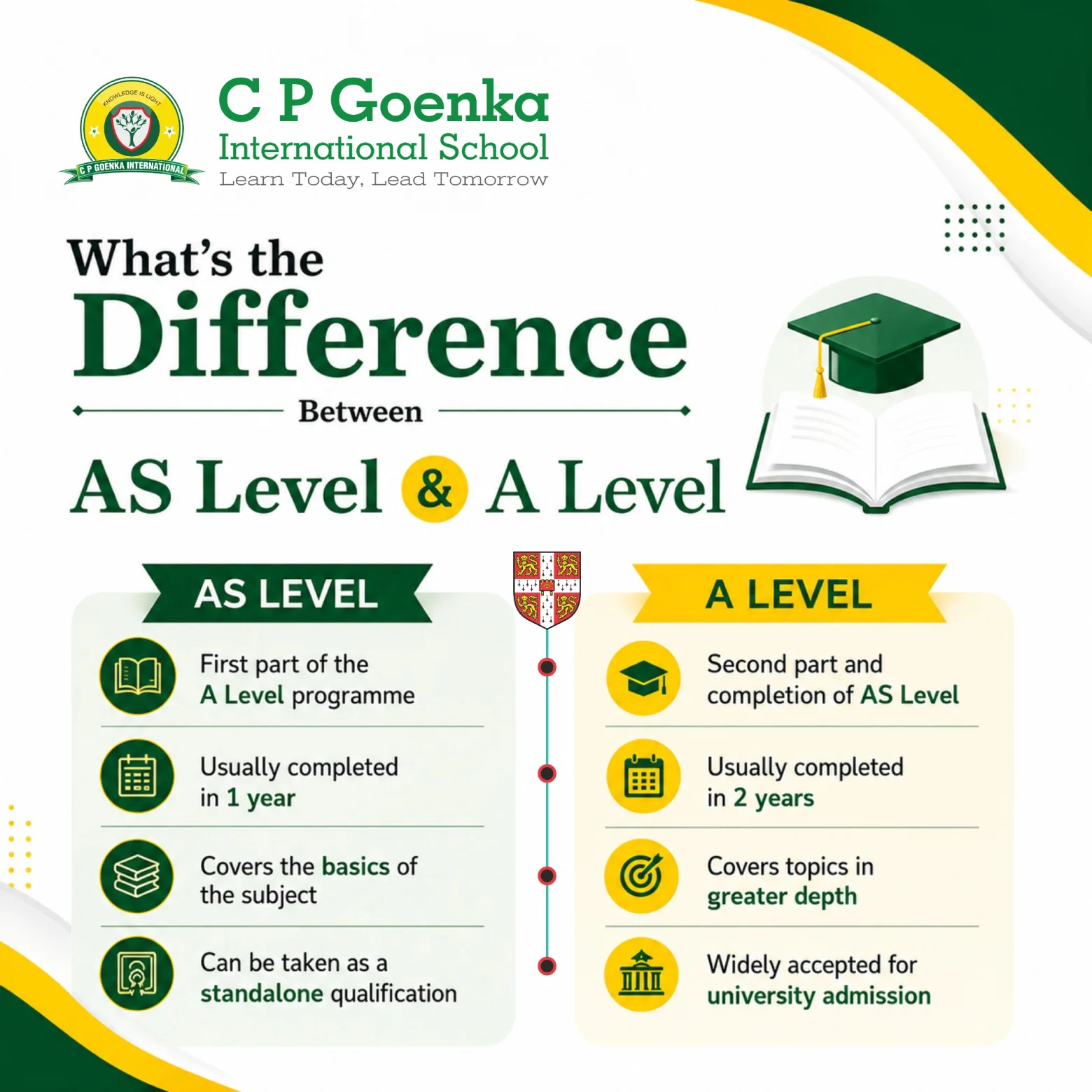
Think of it as the first half of the Cambridge International A Level programme. It usually represents one academic year of study and provides students with a strong foundation in their chosen subjects.
Although it forms part of the complete A Level journey, AS Level is also a recognised qualification on its own. During AS Level, students begin exploring subjects in greater depth than they experienced in IGCSE. Instead of memorising facts, they learn how to:
- Analyse information
- Evaluate different viewpoints
- Solve complex problems
- Present logical arguments
- Apply knowledge in real-world situations
These skills prepare students for the more advanced concepts covered later in A Level.
What is A Level?
A Level, or Advanced Level, is the complete qualification that students generally complete over two years. The first year may consist of AS Level studies, followed by a second year that builds on this foundation with more advanced topics and greater analytical depth. By the time students complete A Level, they have developed subject expertise comparable to the first stage of university education in many disciplines.
The curriculum encourages students to:
- Think independently
- Conduct deeper research
- Interpret evidence
- Solve unfamiliar problems
- Develop academic writing skills
- Communicate ideas confidently
These abilities help students transition smoothly into higher education around the world.
AS Level vs A Level: The Key Differences
| Feature | AS Level | A Level |
|---|---|---|
| Full Form | Advanced Subsidiary Level | Advanced Level |
| Duration | Typically 1 year | Typically 2 years |
| Depth of Study | Foundation level | Advanced and comprehensive |
| Qualification | Standalone qualification | Complete university-preparatory qualification |
| Subject Coverage | Approximately half the syllabus | Full syllabus |
| Academic Difficulty | Moderate | More advanced |
| University Preparation | Good foundation | Preferred for most university admissions |
Does Every Student Need to Complete Both?
Not necessarily.
Cambridge offers flexibility, allowing schools and students to choose the route that best suits their academic plans.
Generally, students may:
- Complete only AS Level
- Progress from AS Level to full A Level
- Sit the complete A Level assessment without taking a separate AS qualification, depending on the school's assessment approach
This flexibility is one of the reasons why Cambridge programmes are appreciated worldwide.
Which One Do Universities Prefer?
For admission to competitive universities, A Level is generally the preferred qualification.
Leading universities across countries such as the UK, USA, Canada, Australia, Singapore, Europe, and many other destinations recognise Cambridge International A Levels for undergraduate admissions.
A Level demonstrates that students have completed advanced academic study and possess the analytical skills expected at university.
AS Level remains valuable because it reflects academic progress and achievement, but students planning for highly competitive degree programmes usually continue to complete the full A Level qualification.
Why Do Students Choose A Levels?
One of the biggest advantages of A Levels is specialisation.
Instead of studying eight or ten different subjects, students usually focus on three or four subjects they genuinely enjoy and intend to pursue further.
For example:
Engineering Student
- Mathematics
- Physics
- Computer Science
Medical Student
- Mathematics
- Physics
- Computer Science
Business Student
- Economics
- Business
- Mathematics
Law Student
- English
- History
- Psychology
This focused approach allows students to build deeper subject knowledge while reducing unnecessary academic overload.
Is A Level More Difficult Than AS Level?
Yes—but that's expected.
AS Level introduces advanced concepts and helps students adjust to the Cambridge learning style.
A Level takes learning one step further by asking students to:
- Interpret complex information
- Evaluate evidence
- Build logical arguments
- Solve unfamiliar questions
- Apply concepts in new situations
Rather than simply recalling textbook content, students are encouraged to think independently and justify their answers.
This emphasis on critical thinking is one reason why Cambridge graduates often adapt well to university learning.
How Are Students Assessed?
Assessment depends on the subject.
Students may be evaluated through:
- Written examinations
- Practical assessments
- Coursework (for selected subjects)
- Research-based assignments
- Problem-solving papers
The focus is not only on remembering information but also on understanding concepts and applying knowledge effectively.
This approach encourages meaningful learning instead of rote memorisation.
Skills Students Develop Through AS and A Levels
Academic success today requires much more than high marks.
Cambridge programmes help students develop lifelong skills, including:
Critical Thinking
Students learn to question information, analyse evidence, and arrive at reasoned conclusions.
Independent Learning
They become confident researchers who take responsibility for their own learning.
Communication Skills
Regular presentations, discussions, essays, and structured answers improve written and verbal communication.
Time Management
Learning to manage multiple complex topics helps students develop skills for prioritising tasks and adhering to deadlines.
Problem Solving
Students are trained to deal with unfamiliar challenges through logical thinking, not by rote memorization.
These portable talents retain their worth well beyond academia.
Choosing the Right Subjects Matters
Subject selection should never be based solely on popularity.
Instead, students should consider:
- Personal interests
- Academic strengths
- Career aspirations
- University admission requirements
- Future flexibility
For instance, a student interested in medicine should carefully choose science subjects, while someone planning a business degree may benefit from Economics, Business, and Mathematics.
Seeking guidance from experienced academic counsellors and teachers can make this decision much easier.
How Parents Can Support Their Child
Parents often worry that Cambridge programmes may be too demanding.
In reality, success comes from the right balance of encouragement, planning, and consistent effort.
Parents can support their child by:
- Encouraging curiosity rather than focusing only on grades.
- Helping create a realistic study routine.
- Promoting healthy habits, including sleep, exercise, and balanced nutrition.
- Maintaining open communication about academic goals and challenges.
- Celebrating progress throughout the learning journey.
Emotional support is just as important as academic guidance.
Why Many Families Choose Cambridge International A Levels
Families increasingly choose Cambridge because it prepares students for a rapidly changing world.
The programme encourages learners to become:
- Independent thinkers
- Confident communicators
- Responsible global citizens
- Effective problem-solvers
- Lifelong learners
Beyond examination results, students gain the confidence to adapt to university life and future careers with greater ease.
Final Thoughts
Understanding the difference between AS Level and A Level helps students and parents make informed educational choices.
In simple terms:
- AS Level is the first stage of advanced Cambridge study and can also be completed as an independent qualification.
- A Level is the complete advanced qualification that provides deeper subject knowledge and stronger preparation for university.
Choosing correctly hinges on a student's academic objectives, personal inclinations, and future visions. With Cambridge's flexible curriculum, students can follow subjects they genuinely enjoy, simultaneously building the knowledge, confidence, and skills necessary for success in higher education and beyond.
At CP Goenka International School, students are guided by experienced educators who understand that every learner's journey is unique. Through personalised academic support, expert counselling, and a future-focused Cambridge curriculum, students are empowered to make confident choices and build a strong foundation for university and lifelong success.


Related Posts

Advantages of the Cambridge Curriculum: A Deep Dive into IGCSE Schools in Pune
Do you want your child to have a well-rounded education? The best school curriculum can make a difference in your kids’ future.

CBSE vs. ICSE vs. IB vs. IGCSE: Navigating India's Education Boards
Selecting an education board shapes the trajectory of a student's academic journey, especially for those eyeing international studies.

All About IGCSE Cambridge Boards
Mumbai is home to a large number of schools, yet each one has a unique curriculum. Curriculum from the CBSE, IGCSE,