To Top


IGCSE vs ICSE
Choosing the Right Board Shouldn't Feel Overwhelming
If you're a parent researching schools, you've probably asked yourself this question more than once:
"Should I choose IGCSE or ICSE for my child?"
It's a big decision. The board your child studies under influences not just academics but also how they think, solve problems, communicate, and prepare for higher education.
Many parents in Mumbai, Thane, Pune, Oshiwara, and nearby areas worry about making the "wrong" choice. Will one board make competitive exams easier? Is another better for studying abroad? Which curriculum helps children enjoy learning instead of simply memorising?
The good news is that there isn't one perfect answer for every child.
The right choice depends on your child's learning style, future aspirations, strengths, and interests.
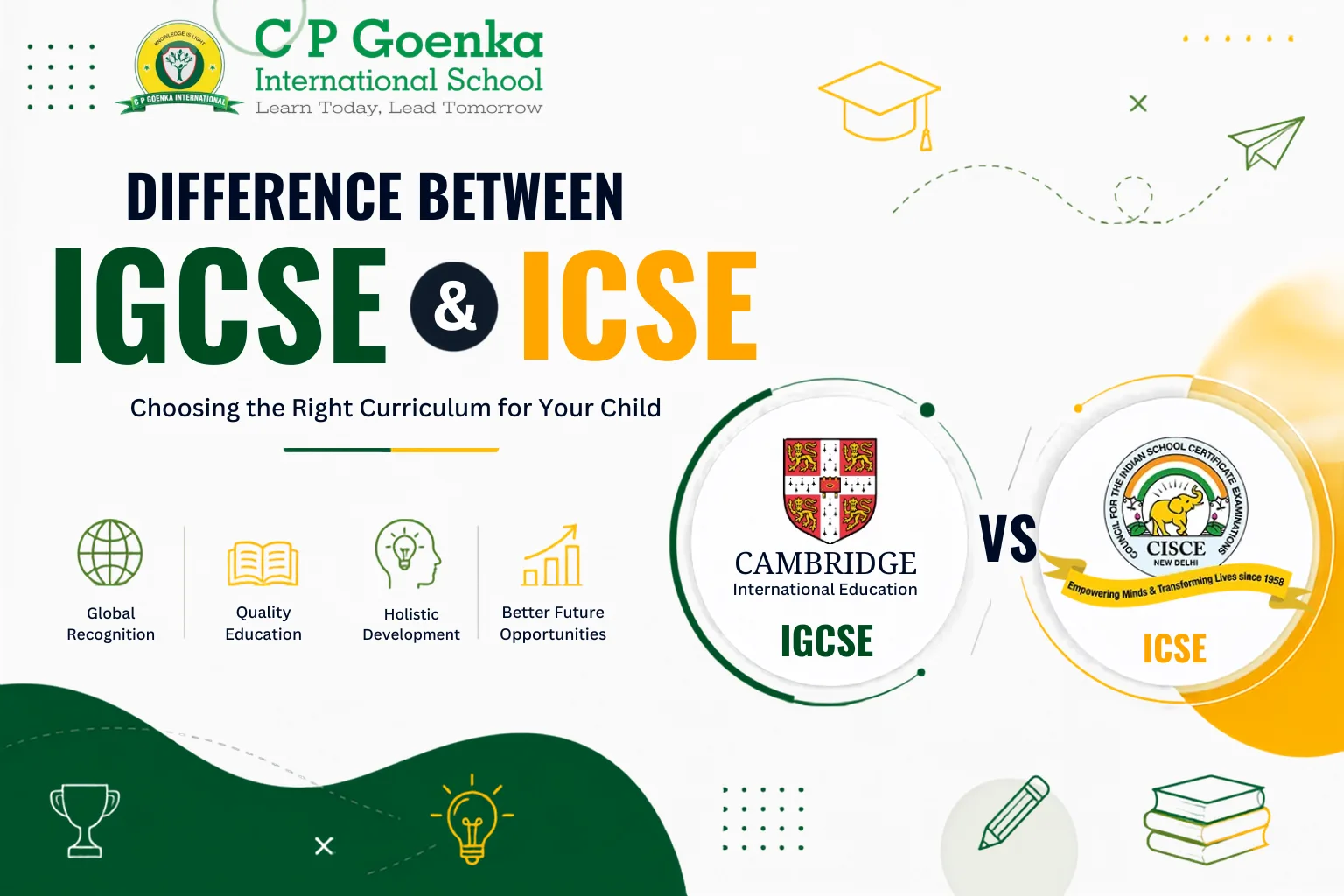
In this guide, we'll explain the IGCSE vs ICSE debate in simple language, compare their strengths and challenges, and help you make an informed decision with confidence.
Understanding ICSE
The Indian Certificate of Secondary Education (ICSE) is conducted by the Council for the Indian School Certificate Examinations (CISCE). It is one of India's most respected educational boards and is known for its balanced, academically rigorous curriculum.
Many parents searching for ICSE schools in Thane or other parts of Maharashtra appreciate its strong foundation in languages, mathematics, and science.
What Makes ICSE Unique?
ICSE focuses on:
- Strong conceptual understanding
- Excellent English language proficiency
- Equal importance to Science, Mathematics, Humanities, and Arts
- Practical knowledge alongside theory
- Internal assessments and project work
Rather than encouraging rote learning alone, ICSE promotes analytical thinking and application-based learning.
Advantages of ICSE
Strong Academic Foundation
ICSE provides depth across subjects, helping students develop comprehensive subject knowledge.
Excellent English Communication Skills
One of the biggest strengths of ICSE is its emphasis on English. Students often develop superior reading, writing, speaking, and comprehension abilities.
Balanced Curriculum
Unlike boards that focus heavily on science, ICSE gives equal weight to literature, arts, languages, environmental education, and social sciences.
Good Preparation for Indian Universities
Many Indian colleges and universities recognise ICSE as a rigorous curriculum that prepares students well for higher education.
Project-Based Learning
Internal assessments encourage research, presentations, and practical application instead of relying solely on examinations.
Challenges of ICSE
Every curriculum has limitations.
Some considerations include:
- Larger syllabus compared to some other boards
- Requires consistent study habits throughout the year
- Can feel demanding for students who prefer lighter academic loads
- Less internationally recognised than Cambridge qualifications
However, for many families seeking academic excellence within India, these are acceptable trade-offs.
Understanding IGCSE
The International General Certificate of Secondary Education (IGCSE) is offered by Cambridge Assessment International Education and is recognised by universities across the world.
Parents exploring IGCSE schools in Mumbai often choose this curriculum because it prepares students for global education and future careers.
What Makes IGCSE Different?
IGCSE is designed to develop learners who are:
- Curious
- Independent thinkers
- Confident communicators
- Creative problem-solvers
- Globally aware citizens
Instead of asking students to memorise facts, Cambridge assessments encourage analysis, reasoning, research, and real-world application.
Advantages of IGCSE
International Recognition
IGCSE qualifications are accepted by universities in countries including:
- United Kingdom
- United States
- Canada
- Australia
- Singapore
- Europe
Students planning international higher education often find this curriculum advantageous.
Flexible Subject Choices
Students can personalise their learning by choosing subjects aligned with their interests and career aspirations.
This flexibility allows children to discover their strengths earlier.
Concept-Based Learning
IGCSE encourages students to ask questions rather than memorise answers.
Classrooms focus on:
- Critical thinking
- Research
- Experiments
- Presentations
- Independent learning
Skill Development
Students naturally build:
- Communication skills
- Leadership
- Collaboration
- Creativity
- Time management
- Research abilities
These skills remain valuable throughout university and professional life.
Practical Assessment
Many subjects include:
- Coursework
- Practical experiments
- Investigations
- Projects
- Case studies
This reduces excessive dependence on final examinations.
Challenges of IGCSE
Parents should also understand some realities.
IGCSE may involve:
- Higher tuition fees in many international schools
- Greater emphasis on independent learning
- Adjustment for students moving from traditional Indian boards
- Careful planning if preparing exclusively for Indian entrance exams
With proper academic guidance, however, these challenges are manageable.
IGCSE vs ICSE: Head-to-Head Comparison
| Feature | ICSE | IGCSE |
|---|---|---|
| Board | CISCE (India) | Cambridge International |
| Recognition | India | Worldwide |
| Learning Style | Balanced with structured academics | Inquiry-based and application-focused |
| Teaching Method | Classroom learning with projects | Interactive, research-oriented |
| Assessment | Internal + Board Exams | Coursework + International Assessments |
| English Language | Excellent emphasis | Strong global communication focus |
| Flexibility | Moderate | High |
| Competitive Exam Preparation | Very good | Good with additional coaching if required |
| Study Abroad | Good | Excellent |
| Critical Thinking | Strong | Exceptional |
| Skill Development | Good | Extensive |
| Best For | Students aiming for Indian higher education | Students seeking international exposure |
Difference Between IGCSE and ICSE
If you're looking for a quick summary of the difference between IGCSE and ICSE, here's what matters most.
ICSE focuses more on
- Academic depth
- Structured syllabus
- Strong English
- Balanced subject coverage
- Indian education system
IGCSE focuses more on
- Conceptual understanding
- Global perspectives
- Practical learning
- Independent thinking
- International university readiness
Neither curriculum is "easy."
They simply prepare students differently.
Cambridge Board vs ICSE: Which Is Better?
The question shouldn't really be:
Which board is better?
Instead, ask:
Which board is better for my child?
Let's look at different situations.
Choose ICSE if your child:
- Enjoys structured learning
- Plans to pursue higher education in India
- Is comfortable with comprehensive academic study
- Wants strong language development
Choose IGCSE if your child:
- Loves asking questions
- Enjoys projects and research
- Learns best through exploration
- May study abroad
- Wants an internationally recognised curriculum
The Cambridge board vs ICSE comparison ultimately comes down to your child's personality and future goals.
Which Board Is Better for IIT-JEE and NEET?
This is one of the most common concerns among parents.
ICSE Advantage
ICSE builds strong fundamentals in:
- Mathematics
- Physics
- Chemistry
- Biology
These fundamentals can support preparation for competitive examinations like:
- IIT-JEE
- NEET
- CUET
Many students supplement their school curriculum with coaching regardless of the board.
Can IGCSE Students Crack IIT-JEE or NEET?
Absolutely.
Many successful IIT and medical aspirants come from Cambridge schools.
However, students usually need additional coaching because entrance examinations follow Indian national syllabi.
The board itself is not a limitation.
Planning matters more.
Which Board Is Better for Studying Abroad?
If your child plans to pursue higher education overseas, IGCSE generally offers an advantage.
Why?
Universities worldwide are already familiar with Cambridge qualifications.
Students also develop:
- Research skills
- Independent learning habits
- Presentation abilities
- Analytical thinking
These competencies align well with international university expectations.
That said, ICSE students also gain admission to top global universities, especially when supported by strong academic performance and extracurricular achievements.
How C.P. Goenka International School Helps Every Child Succeed
At CP Goenka International School, we understand that every child learns differently.
Some students thrive in structured academic environments.
Others flourish when encouraged to explore, investigate, and think independently.
That's why our philosophy goes beyond marks.
We believe in developing each child's personality along with percentage.
Across our campuses in ,Oshiwara, Thane, Pune, and Walkeshwar, learning is designed to help students become confident individuals, responsible citizens, and lifelong learners.
Our educators focus on:
- Individual attention
- Conceptual understanding
- Experiential learning
- Technology-enabled classrooms
- Communication and leadership skills
- Holistic personality development
- Strong academic outcomes
Whether your family is looking for the best international curriculum, researching IGCSE schools in Mumbai, or comparing ICSE schools in Thane, our admissions counsellors work closely with parents to understand each child's strengths before recommending the right academic pathway.
Education is never about choosing the most popular board.
It's about choosing the environment where your child will thrive.
How to Choose the Right Board: A Parent's Checklist
Before making your decision, ask yourself these questions:
- Does my child enjoy memorising or exploring?
- Is my child naturally curious and independent?
- Are we considering higher education abroad?
- Is our priority Indian competitive exams?
- Does my child prefer practical learning or structured classroom teaching?
- Which learning environment will keep my child motivated for the next several years?
The answers often make the decision much clearer.
Final Thoughts
The debate around IGCSE vs ICSE doesn't have a universal winner.
Both boards offer high-quality education and can lead to successful careers.
If your priority is a structured Indian curriculum with strong academic depth, ICSE is an excellent choice.
If you're looking for internationally recognised qualifications, inquiry-based learning, and a curriculum that develops future-ready skills, IGCSE may be the better fit.
The most important factor isn't the board—it's choosing a school that understands your child's potential and nurtures it every day.
At CP Goenka International School, we are committed to developing each child's personality along with percentage, ensuring every learner receives the guidance, opportunities, and support needed to excel academically and personally.
If you're still unsure which curriculum is right for your child, speaking with experienced educators and visiting a campus can provide valuable clarity. Sometimes, seeing classrooms in action is the best way to make a confident decision.
Frequently Asked Questions (FAQs)
1. Which is better: IGCSE or ICSE?
Neither board is universally better. ICSE is ideal for students seeking a structured Indian curriculum, while IGCSE is better suited for learners who benefit from inquiry-based education and may plan to study abroad.
2. What is the main difference between IGCSE and ICSE?
The primary difference between IGCSE and ICSE is their approach to learning. ICSE offers a structured Indian curriculum with comprehensive subject coverage, whereas IGCSE follows an international curriculum that emphasises conceptual understanding, critical thinking, and practical application.
3. Is IGCSE harder than ICSE?
Both boards are academically rigorous in different ways. ICSE has a broader syllabus with detailed content, while IGCSE focuses more on analytical thinking, coursework, and application-based assessments.
4. Can IGCSE students appear for IIT-JEE or NEET?
Yes. IGCSE students are fully eligible to appear for IIT-JEE, NEET, and other Indian competitive examinations. Many students choose additional coaching to align with entrance exam syllabi.
5. Why choose CP Goenka International School?
CP Goenka International School provides a learner-centric environment where academic excellence is balanced with personality development. With campuses in Oshiwara, Thane, Pune, and Walkeshwar, experienced faculty, and a commitment to developing each child's personality along with percentage, the school prepares students for success in India and across the world.


Related Posts

Advantages of the Cambridge Curriculum: A Deep Dive into IGCSE Schools in Pune
Do you want your child to have a well-rounded education? The best school curriculum can make a difference in your kids’ future.

CBSE vs. ICSE vs. IB vs. IGCSE: Navigating India's Education Boards
Selecting an education board shapes the trajectory of a student's academic journey, especially for those eyeing international studies.

All About IGCSE Cambridge Boards
Mumbai is home to a large number of schools, yet each one has a unique curriculum. Curriculum from the CBSE, IGCSE,