
To Top



Education Boards in India: A Parent's Complete Guide to Choosing the Right Curriculum for Your Child
Choosing a school is one of the biggest decisions parents make, but before selecting a school, there's another equally important choice to consider—the education board. With several Education Boards in India offering different teaching methods, assessment styles, and learning philosophies, it's natural to wonder which one will best support your child's future.
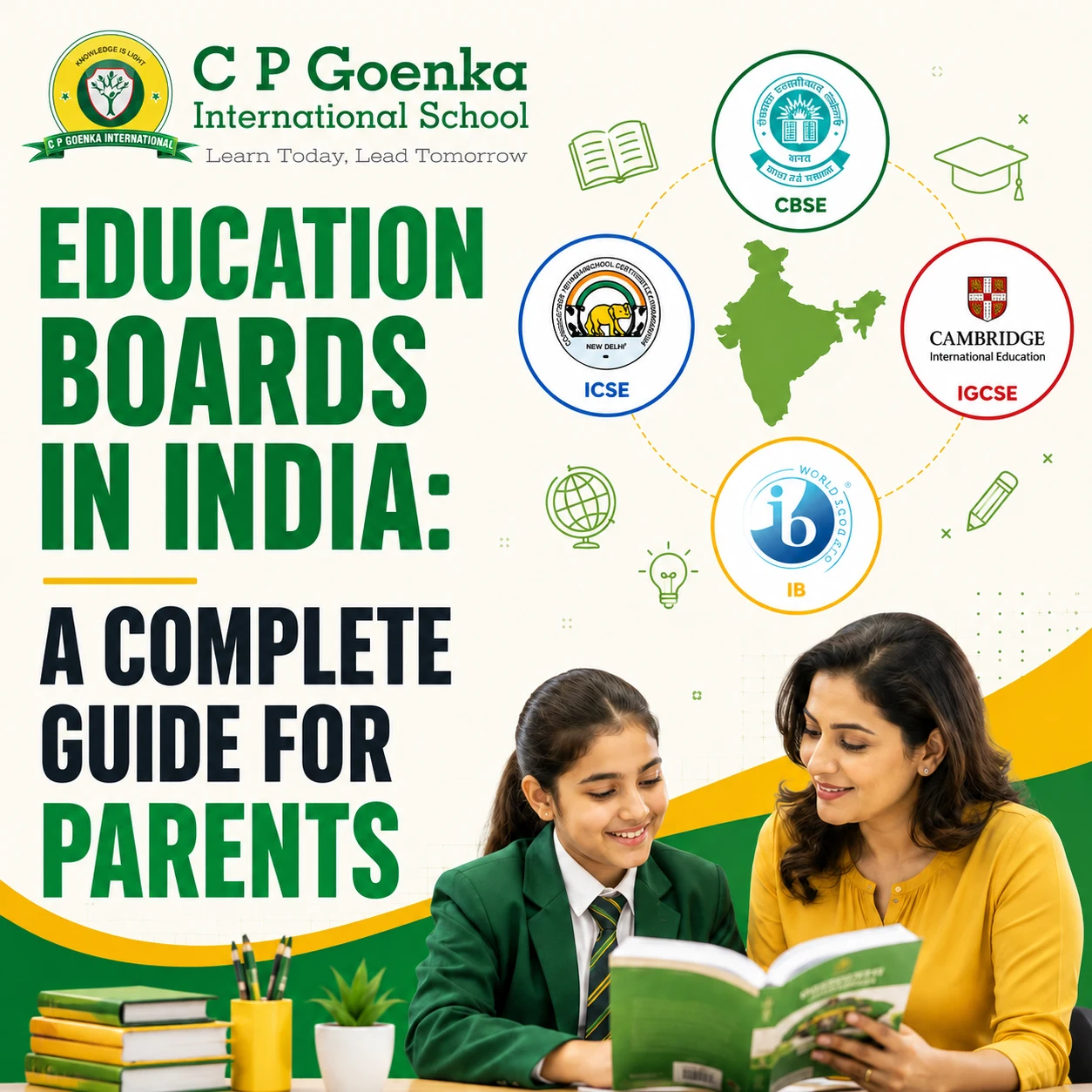
Many parents begin their search with questions like: How many boards are there in India? Which curriculum is best? Should we choose CBSE, ICSE, Cambridge, or another option? While these are valid questions, the answer isn't always straightforward. Every child learns differently, and the ideal curriculum depends on their interests, strengths, aspirations, and preferred learning style.
Today's world demands much more than academic excellence. Children need to become critical thinkers, effective communicators, problem-solvers, and lifelong learners. The right curriculum should help them develop these essential skills while building a strong academic foundation.
In this guide, we'll explore the major Education Boards in India, explain how they differ, discuss their advantages, and help you understand what to look for when choosing the right curriculum. Whether you're considering a preschool admission or planning your child's secondary education, this guide will help you make an informed decision.
How Many Education Boards Are There in India?
India has one of the largest and most diverse education systems in the world. There isn't just one Indian education board—instead, students can choose from national boards, state boards, international curricula, and open schooling systems.
Some of the most recognised education boards include:
- Central Board of Secondary Education (CBSE)
- Council for the Indian School Certificate Examinations (CISCE), which conducts ICSE and ISC
- Cambridge International Education (Cambridge Primary, Lower Secondary, IGCSE, and A Levels)
- International Baccalaureate (IB)
- National Institute of Open Schooling (NIOS)
- State Education Boards such as Maharashtra, Gujarat, Karnataka, Tamil Nadu, and others
In total, there are more than 30 recognised education boards in India, including central, state, international, and specialised boards.
Each board follows its own curriculum framework, teaching methodology, assessment pattern, and educational philosophy. Understanding these differences is the first step towards choosing the right learning environment for your child.
Why Choosing the Right Education Board Matters
The education board shapes much more than classroom learning. It influences how children think, solve problems, communicate ideas, and prepare for future opportunities.
For example, some curricula focus on conceptual clarity and competitive examinations, while others emphasise inquiry-based learning, creativity, research, and practical application.
Parents often assume that selecting the "best" board guarantees success. In reality, success depends on finding the curriculum that aligns with a child's personality, interests, and long-term goals.
When evaluating different Education Boards in India, consider factors such as:
- Teaching methodology
- Assessment approach
- Subject flexibility
- Academic rigour
- Skill development
- University recognition
- Career aspirations
- Co-curricular opportunities
A curriculum that encourages curiosity and confidence can have a lasting impact on a child's educational journey.
Understanding the Major Education Boards in India
CBSE (Central Board of Secondary Education)
CBSE is one of the most popular education boards in the country and is followed by thousands of schools across India.
Its curriculum is designed to provide conceptual understanding while maintaining consistency across affiliated schools. The syllabus is closely aligned with NCERT textbooks, making it a preferred choice for students preparing for national-level competitive examinations.
Key Features
- Standardised curriculum across India
- Strong focus on Mathematics and Science
- Continuous curriculum revisions
- Competency-based learning initiatives
- Balanced academic structure
Who Is It Suitable For?
CBSE is often chosen by families who relocate frequently because of the large number of affiliated schools across India. It is also suitable for students who plan to appear for competitive examinations such as engineering, medical, or government entrance tests.
Over the years, CBSE has gradually shifted from rote memorisation towards conceptual learning and practical application, helping students develop analytical thinking alongside academic knowledge.
ICSE (Indian Certificate of Secondary Education)
The ICSE curriculum is widely recognised for its comprehensive approach to education. Rather than focusing only on examinations, it encourages students to build strong language skills, analytical thinking, and a broad understanding of different subjects.
Key Features
- Strong emphasis on English language proficiency
- Balanced focus on Science, Mathematics, Humanities, and Arts
- Detailed curriculum
- Project-based assignments
- Internal assessments
Who Is It Suitable For?
Students who enjoy reading, writing, creative thinking, and interdisciplinary learning often benefit from the ICSE curriculum.
The board encourages learners to develop communication skills, research abilities, and subject depth while maintaining academic balance across multiple disciplines.
Its comprehensive syllabus prepares students for higher education by encouraging independent learning rather than simply memorising textbook content.
Cambridge International Education
Cambridge International Education has become increasingly popular among families seeking a globally recognised curriculum.
It offers a flexible learning pathway that includes Cambridge Primary, Lower Secondary, IGCSE, and Cambridge International A Levels.
Unlike traditional examination-focused systems, Cambridge encourages students to ask questions, investigate ideas, analyse information, and apply their knowledge to real-world situations.
Key Features
- Internationally recognised qualifications
- Flexible subject combinations
- Inquiry-based learning
- Skill-focused assessments
- Strong emphasis on critical thinking
Who Is It Suitable For?
Cambridge is ideal for students who enjoy independent learning and aspire to study at leading universities in India or abroad.
The curriculum develops transferable skills such as research, collaboration, communication, and problem-solving, which are increasingly valued in higher education and modern workplaces.
Instead of measuring only academic performance, Cambridge encourages students to become confident, responsible, reflective, and engaged learners.
International Baccalaureate (IB)
The International Baccalaureate is known worldwide for its holistic educational philosophy.
Rather than separating knowledge into isolated subjects, the IB encourages students to make meaningful connections across disciplines while developing intellectual curiosity and global awareness.
Key Features
- Inquiry-driven learning
- Research-based assignments
- Interdisciplinary education
- Community engagement
- Global perspective
Students are encouraged to explore ideas, ask meaningful questions, participate in discussions, and develop solutions to real-world challenges.
The IB places equal importance on academic achievement, creativity, leadership, emotional development, and social responsibility.
As a result, graduates often demonstrate excellent communication skills, adaptability, and confidence when transitioning to university education.
State Education Boards
Every Indian state has its own education board designed to meet regional educational requirements.
For example, students studying in Maharashtra follow the Maharashtra State Board curriculum, while other states have their respective boards.
These curricula often emphasise regional languages, local history, and state-specific educational priorities.
Many families choose state boards because they provide affordability, accessibility, and alignment with regional competitive examinations.
CBSE vs ICSE vs Cambridge vs IB: Quick Comparison
| Feature | CBSE | ICSE | Cambridge | IB |
|---|---|---|---|---|
| Learning Style | Structured | Comprehensive | Inquiry-based | Holistic |
| Focus | Competitive exams | Balanced academics | Global learning | Research & critical thinking |
| Flexibility | Moderate | Moderate | High | High |
| International Recognition | Good | Good | Excellent | Excellent |
| Best For | JEE, NEET | Strong academics | Global universities | Well-rounded learners |
Although every curriculum aims to educate children, the learning experience differs considerably.
CBSE focuses on conceptual clarity with structured progression.
ICSE offers detailed subject knowledge alongside strong language development.
Cambridge encourages inquiry, analytical thinking, and international perspectives
IB promotes interdisciplinary learning, research, and holistic development.
State boards provide regionally relevant education while supporting students preparing for state-level opportunities.
Instead of asking which board is "better," parents should ask which curriculum best supports their child's learning style and future aspirations.
How to Choose the Right Curriculum for Your Child
Choosing an education board is not simply about rankings or popularity. It requires understanding your child's individual needs.
Understand Your Child's Learning Style
Every child learns differently.
Some enjoy structured lessons and clear instructions, while others learn best through discussion, experimentation, projects, and exploration
Observe how your child approaches learning.
Do they ask many questions?
Do they enjoy solving practical problems?
Are they creative thinkers?
Understanding these preferences will help narrow down suitable curriculum options.
Consider Long-Term Goals
Think beyond primary school.
Would your child like to pursue higher education in India or abroad?
Are they interested in engineering, medicine, business, arts, design, or research?
Different curricula prepare students differently for future academic pathways.
Planning early helps parents make informed decisions without unnecessary curriculum changes later.
Evaluate the School Alongside the Curriculum
The education board is only one part of the overall learning experience.
The quality of teachers, school culture, classroom environment, leadership, extracurricular opportunities, technology integration, and student wellbeing initiatives often have an even greater influence on a child's success.
Two schools following the same curriculum can deliver completely different educational experiences.
Visiting the campus, interacting with teachers, and understanding the school's educational philosophy are equally important.
Why International Curricula Are Becoming Increasingly Popular in India
The way children learn has changed significantly over the past decade. Earlier, academic success was often measured by examination scores alone. Today, parents and educators recognise that students also need communication skills, creativity, critical thinking, collaboration, adaptability, and digital literacy to succeed in higher education and future careers.
This shift has led many families to explore international curricula alongside traditional Education Boards in India.
International programmes such as Cambridge focus on helping students understandconcepts rather than memorise information. Classroom discussions, research projects, presentations, group activities, and real-world problem-solving become an integral part of the learning experience.
Students are encouraged to ask questions, investigate different perspectives, and apply their knowledge in meaningful ways. This approach not only builds academic confidence but also prepares learners for university education and professional environments where independent thinking is highly valued.
However, choosing an international curriculum does not necessarily mean planning to study abroad. Many Indian students successfully pursue higher education in leading universities across India after completing internationally recognised programmes. Likewise, students from CBSE and ICSE backgrounds also gain admission to prestigious institutions worldwide
The focus should therefore remain on selecting a curriculum that matches your child's interests, learning preferences, and future aspirations.
Common Misconceptions About Education Boards in India
Parents often encounter conflicting opinions while researching different Indian education boards. Understanding the facts behind these misconceptions can make the decision-making process much easier.
"CBSE Is Only for Engineering and Medical Students"
While CBSE aligns well with national competitive examinations such as JEE and NEET, the curriculum is not limited to students pursuing science. It provides a balanced academic foundation suitable for careers in commerce, humanities, law, management, and many other fields.
Recent curriculum updates have also introduced competency-based learning, helping students develop practical application skills alongside theoretical knowledge.
"International Curricula Are Only for Students Going Abroad"
International curricula are designed to develop transferable skills such as communication, research, collaboration, creativity, and analytical thinking. These skills are valuable regardless ofwhether a student chooses an Indian or international university.
Many universities in India readily accept students from Cambridge and other internationally recognised curricula, provided they meet the required eligibility criteria.
"One Board Is BetterThan All Others"
There is no universally superior curriculum.
Every education board has its own strengths.
A curriculum that works exceptionally well for one student may not suit another. The best choice depends on the child's personality, interests, academic goals, and preferred learning style rather than rankings or public perception.
Questions Every Parent Should Ask Before Choosing a School
Selecting the right curriculum becomes easier when parents evaluate the overall learning environment instead of focusing only on the education board.
Before finalising a school, consider asking these important questions:
Does the school encourage conceptual learning?
Students understand subjects more effectively when teachers focus on concepts instead of rote memorisation.
Are teachers experienced and regularly trained?
Even the strongest curriculum delivers the best outcomes only when supported by skilled and passionate educators.
How are students assessed?
Look beyond examination scores. Schools that include projects, presentations, practical work, and continuous assessments often help children develop a broader range of skills.
What opportunities exist beyond academics?
Sports, performing arts, technology, leadership programmes, community service, innovation labs,and extracurricular activities contribute significantly to a child's overall development.
How does the school support individual learners?
Every child progresses differently. Schools that provide personalised attention, counselling, and academic support create a more positive learning experience.
Choosing the Right Education Board at Different Stages of Schooling
Parents often believe they must decide their child's complete educational pathway from the very beginning. In reality, educational needs evolve as children grow.
Preschool and Early Years
At this stage, children benefit most from activity-based learning that develops curiosity, communication, creativity, and social skills.
The focus should be on creating a joyful learning environment where children build confidence through exploration and play.
Primary School
As students enter primary grades, they begin strengthening literacy, numeracy, problem-solving, and foundational academic skills.
A curriculum that encourages questioning, collaboration, and conceptual understanding can help children develop a lifelong love for learning.
Middle School
During middle school, students gradually become independent learners.
This is an ideal stage for developing analytical thinking, project work, research skills, digital literacy, and effective communication.
Parents should also begin considering their child's evolving interests and future educational goals.
Secondary and Senior Secondary
At this stage, subject choices become increasingly important.
Students preparing for competitive examinations, specialised university programmes, or international higher education should choose a curriculum that aligns with their long-term aspirations while continuing to support holistic development.
Choosing the Right School Matters as Much as Choosing the Right Board
While selecting the right curriculum is important, the school's learning environment plays an equally significant role.
At C P Goenka International School, students benefit from future-ready learning environments that encourage curiosity, creativity, academic excellence, and holistic development.
With campuses across Mumbai, Thane, Pune, and Navi Mumbai (Ulwe), the school offers internationally recognised curricula supported by experienced educators, modern infrastructure, and student-centred teaching practices.
Parents are encouraged to explore the curriculum options available at each campus and choose the pathway that best aligns with their child's interests, strengths, and future aspirations.
With campuses in Mumbai, Thane, Pune, and Ulwe, the school offers families the opportunity to choose a curriculum that aligns with their child's goals while preparing them to become confident, responsible, and globally aware citizens.
The right education board is not simply about today's academics—it is about building the foundation for tomorrow's opportunities. By understanding the strengths of each curriculum and selecting a school that shares your educational values, you can give your child the confidence and skillsto succeed in an ever-changing world.


Related Posts

Advantages of the Cambridge Curriculum: A Deep Dive into IGCSE Schools in Pune
Do you want your child to have a well-rounded education? The best school curriculum can make a difference in your kids’ future.

CBSE vs. ICSE vs. IB vs. IGCSE: Navigating India's Education Boards
Selecting an education board shapes the trajectory of a student's academic journey, especially for those eyeing international studies.

All About IGCSE Cambridge Boards
Mumbai is home to a large number of schools, yet each one has a unique curriculum. Curriculum from the CBSE, IGCSE,