
To Top







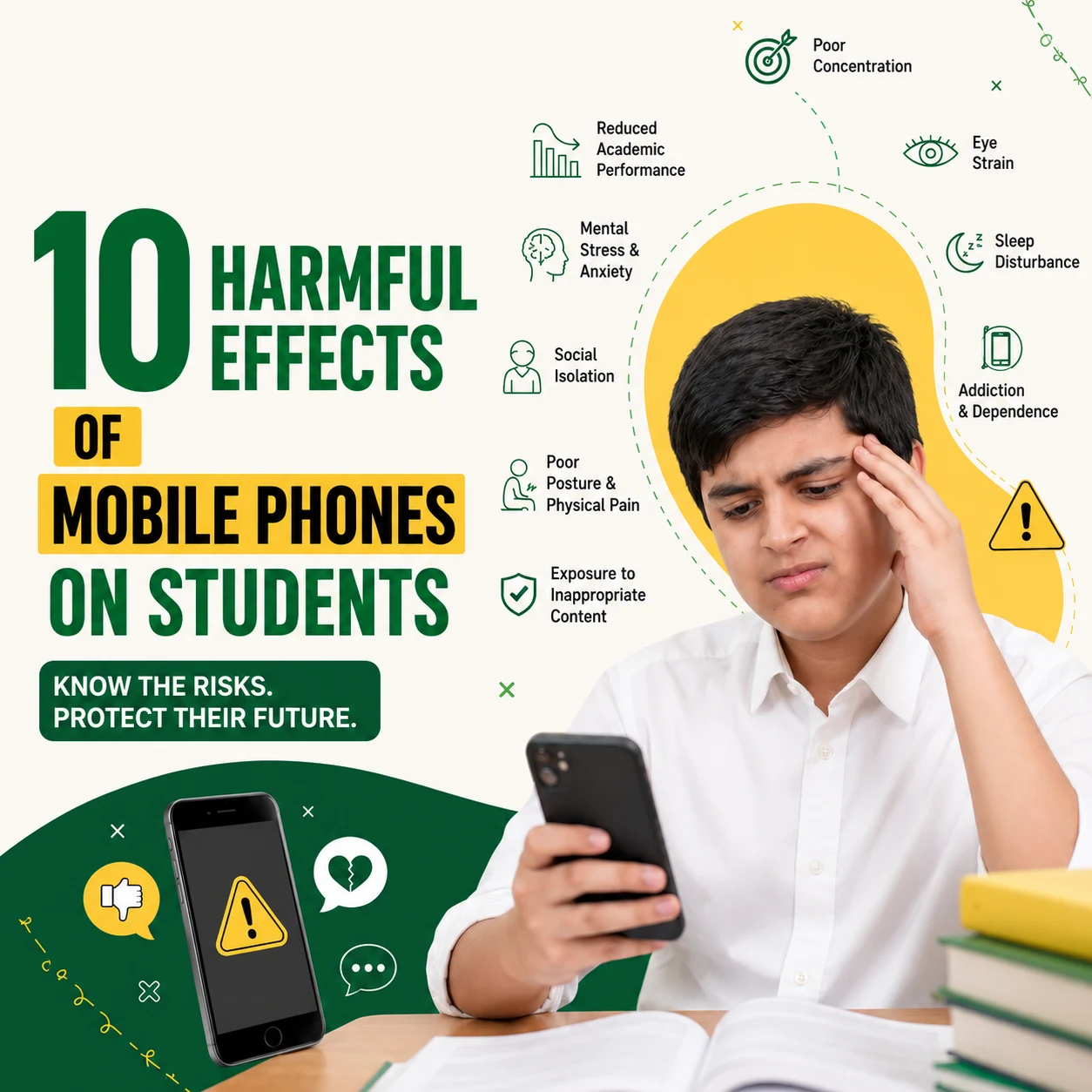
10 Harmful Effects of Mobile Phones on Students
Helping children build a healthier relationship with technology—one mindful step at a time.
Have you ever had to say, "Just five more minutes," only to hear the same reply back from your child?
It's a scene that plays out in many homes. Dinner is ready, but your child is still watching videos. Homework is open on the table, yet notifications keep pulling their attention away. Bedtime arrives, but the phone screen continues to glow under the blanket.
If this sounds familiar, you're certainly not alone.
The truth is, mobile phones have become an essential part of modern life. They help students learn, stay connected with teachers, explore new ideas, and even collaborate on school projects. Technology itself isn't the problem.
The challenge begins when screen time quietly replaces sleep, outdoor play, family conversations, focused learning, and meaningful social interactions. Children and teenagers are still developing emotionally, physically, and mentally. Their growing brains are especially sensitive to habits that form early.
As parents, it's natural to wonder:
- How much screen time is too much?
- Is my child becoming addicted to the phone?
- How do I set limits without constant arguments?
These are important questions, and the answers aren't about banning technology altogether. They're about helping children develop healthy digital habits that will benefit them for life.
Let's look at ten ways excessive mobile phone use can affect students—and, more importantly, what parents can do about it.
1. Sleep Deprivation: When One More Video Becomes One More Hour
Many children promise they'll put their phone away after "just one more video." Before they realize it, an hour has passed.
The blue light emitted from mobile screens interferes with the body's natural production of melatonin—the hormone responsible for helping us sleep. Combined with endless scrolling, exciting games, and social media notifications, it becomes difficult for the brain to switch off.
A tired child may:
- Wake up feeling exhausted
- Struggle to concentrate in class
- Become irritable throughout the day
- Lose motivation to participate in activities
Imagine a student who sleeps at midnight after scrolling through reels. By morning, they aren't just sleepy—they're carrying that fatigue into every lesson, every conversation, and every decision they make.
Quality sleep is one of the strongest foundations for learning and emotional wellbeing.
2. Shrinking Attention Spans: The Cost of Constant Scrolling
Today's children consume information faster than ever.
Short-form videos lasting 15 to 30 seconds are entertaining, but they also train the brain to expect constant stimulation.
Reading a chapter from a textbook suddenly feels "boring."
Completing a mathematics worksheet seems "too slow."
Writing an essay becomes frustrating because it requires sustained focus.
Over time, students may find it increasingly difficult to:
- Read books
- Solve complex problems
- Sit through classroom lessons
- Complete homework without checking their phones
The ability to focus is like a muscle. When children rarely practise deep concentration, that muscle gradually weakens.
3. Cyberbullying and Social Anxiety: The Pressure Behind the Screen
School friendships don't end when the final bell rings anymore.
Group chats, social media, online gaming, and messaging apps continue the conversation long after students return home.
While digital communication has many positives, it also creates opportunities for:
- Cyberbullying
- Online exclusion
- Negative comments
- Unrealistic comparisons
- Fear of Missing Out (FOMO)
A child may constantly wonder:
"Why wasn't I invited?"
"Why did everyone like their photo but not mine?"
"What if I miss something important?"
These thoughts can quietly affect confidence and increase anxiety.
Unlike traditional bullying, online bullying can follow a child everywhere—even into what should be the safety of their own bedroom.
4. Physical Health Problems: More Than Just Tired Eyes
Children's bodies are still growing, and long hours on mobile phones can affect them physically.
Common issues include:
- Digital eye strain
- Blurred vision
- Dry eyes
- Frequent headaches
- Neck pain
- Poor posture
Think about how many students spend hours looking downward at a phone.
Over months and years, this repeated posture places unnecessary pressure on the neck, shoulders, and spine.
Regular movement, proper seating, and frequent screen breaks can make a remarkable difference.
5. Less Outdoor Play, Less Healthy Growth
Remember how childhood once meant cycling around the neighbourhood, playing cricket, hide-and-seek, or simply running around the park?
Many children today are replacing active play with passive screen time.
The consequences extend beyond physical fitness.
Outdoor play develops:
- Balance and coordination
- Creativity
- Teamwork
- Problem-solving
- Confidence
- Emotional resilience
Children who spend most of their free time indoors may gradually become less active, gain unhealthy weight, and miss opportunities to build important life skills through play.
Sometimes the best classroom isn't inside a building—it's the playground.
6. Academic Performance Can Begin to Slip
Many students believe they can study while checking messages, watching videos, or listening to social media updates.
Research consistently shows that multitasking isn't truly multitasking. The brain simply keeps switching between tasks, making learning slower and less effective.
For example:
A student begins solving science questions.
A notification appears.
They check it.
Then another message arrives.
By the time they return to the textbook, they've forgotten where they stopped.
These constant interruptions reduce comprehension, increase mistakes, and make homework take much longer than necessary.
Focused study almost always produces better learning than distracted study.
7. Dopamine Addiction: Chasing the Next Notification
Every like, message, or notification gives the brain a small reward.
This releases dopamine, the chemical associated with pleasure and motivation.
The problem isn't dopamine itself.
The problem begins when children rely on constant digital rewards instead of finding satisfaction in:
- Reading
- Sports
- Music
- Art
- Conversations
- Learning something new
Gradually, ordinary daily activities may feel less exciting because they don't provide instant gratification.
Children may repeatedly unlock their phones without even realising why.
This habit isn't about lack of discipline—it reflects how powerful app design has become.
8. Social Skills Can Slowly Fade
Have you ever noticed a group of teenagers sitting together while everyone is looking at a different screen?
They're physically together.
But emotionally, they're somewhere else.
Face-to-face communication teaches children how to:
- Read body language
- Maintain eye contact
- Listen actively
- Show empathy
- Handle disagreements respectfully
These skills cannot be fully learned through text messages or emojis.
Students who spend most of their social lives online may find real-life conversations more uncomfortable over time.
Healthy friendships still grow strongest through genuine human connection.
9. Emotional Outbursts When Phones Are Taken Away
Many parents recognise this situation immediately.
You ask your child to switch off the phone.
Suddenly they become angry, frustrated, argumentative, or withdrawn.
This isn't always simple stubbornness.
When children become heavily dependent on digital stimulation, removing the device can temporarily feel uncomfortable.
Signs may include:
- Irritability
- Restlessness
- Mood swings
- Difficulty relaxing
- Constant requests for the phone
These emotional reactions often become stronger when healthy routines, hobbies, and family interactions have gradually been replaced by excessive screen use.
10. Exposure to Inappropriate Content
The internet offers incredible educational opportunities.
Unfortunately, it also contains material that children are not emotionally ready to process.
Without proper supervision, students may accidentally encounter:
- Violent content
- Misinformation
- Explicit material
- Online scams
- Harmful challenges
- Unsafe online interactions
Even a simple search can sometimes lead children toward content they never intended to find.
Open communication between parents and children is often more effective than relying solely on restrictions.
Children should feel comfortable asking questions instead of hiding what they have seen.
Practical Ways Parents Can Build Healthy Digital Habits
The goal isn't to remove technology from children's lives.
It's to help them use it wisely.
Here are a few realistic strategies that families often find helpful.
1. Create Screen-Free Family Moments
Choose simple routines where phones stay away.
For example:
- Dinner time
- Family game nights
- Evening walks
- Weekend outings
These moments encourage conversation and strengthen family relationships.
2. Be the Example They Watch
Children learn far more from what we do than what we say.
If parents frequently check their phones during conversations, children naturally follow the same behaviour.
Showing balanced technology use sends a powerful message.
3. Keep Bedrooms Screen-Free at Night
Charging phones outside the bedroom helps reduce late-night scrolling and encourages healthier sleep routines.
A simple family charging station can make this habit easier for everyone.
4. Encourage Activities Beyond Screens
Help children discover interests that don't depend on a mobile phone.
This could include:
- Sports
- Music
- Dance
- Reading
- Art
- Gardening
- Cooking
- Nature walks
The more meaningful experiences children have offline, the less dependent they become on online entertainment.
Helping Children Grow in a Digital World
Technology isn't going away—and neither should it.
Mobile phones can support creativity, learning, communication, and curiosity when used thoughtfully. The goal isn't to fear technology but to teach children how to manage it responsibly.
At C P Goenka International School, we believe education extends far beyond textbooks. We focus on holistic development, encouraging students to balance academics with sports, creative arts, outdoor experiences, leadership opportunities, and responsible digital citizenship. By helping children develop self-discipline, emotional intelligence, and healthy technology habits, we prepare them not just for examinations, but for life.
Every family's journey with screen time is different. Small, consistent changes often have the greatest impact.


Related Posts

Advantages of the Cambridge Curriculum: A Deep Dive into IGCSE Schools in Pune
Do you want your child to have a well-rounded education? The best school curriculum can make a difference in your kids’ future.

CBSE vs. ICSE vs. IB vs. IGCSE: Navigating India's Education Boards
Selecting an education board shapes the trajectory of a student's academic journey, especially for those eyeing international studies.

All About IGCSE Cambridge Boards
Mumbai is home to a large number of schools, yet each one has a unique curriculum. Curriculum from the CBSE, IGCSE,